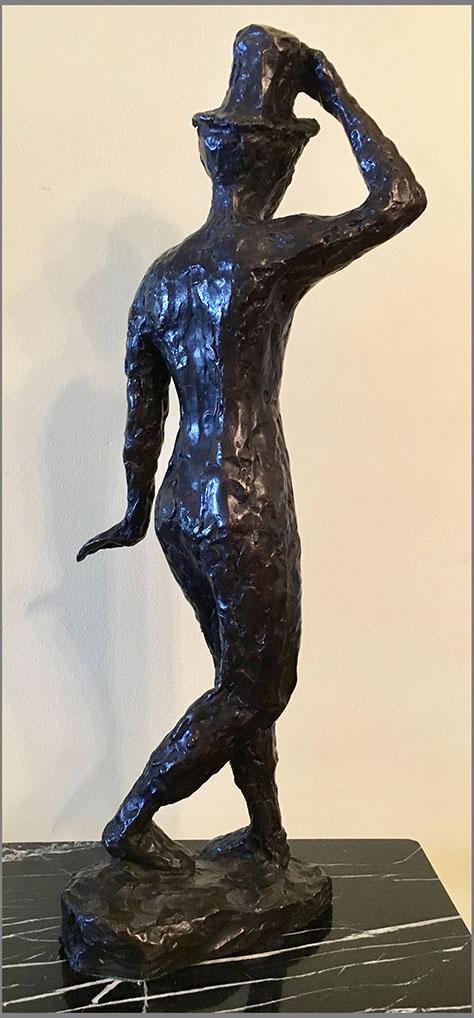
Arbit Blatas
1908-1999
Born in Kaunas on 19 November 1908, Arbit Blatas was a precocious talent who began exhibiting in his native country at the age of 15. He left for Paris and, at the age of 21, became the youngest member of the School of Paris.
When Blatas was 24, the Galerie Nationale du Jeu de Paume in Paris first acquired some of his paintings; he had already become a colleague and friend of many of the great figures of the Paris art world, such as Vlaminck, Soutine, Picasso, Utrillo, Braque, Zadkine, Léger and Derain. He was to paint and sculpt them all, as well as Bonnard, Vuillard, Matisse, Dufy, Van Dongen, Cocteau, Marquet and many others. His 30 portraits in oil and bronzes are considered a unique document of the painters and sculptors of that dynamic period in 20th-century French painting..
In the 1930s, Blatas exhibited in London and New York, as well as in his adoptive home of Paris.
Fleeing Nazi-occupied Europe in 1941 for the United States, Blatas became an American citizen. After the war, Blatas divided his life between New York and France; in 1947, he was elected a life member of the Salon d'Automne, in the latter country. His life-size bronze of his colleague and friend Chaim Soutine, created in 1967, was highly admired by André Malraux. In 1987, the City of Paris installed the statue in Montparnasse and conferred on Blatas the Médaille de Vermeil. A life-size statue of another close friend and colleague, Jacques Lipchitz, now stands in the garden of the Hotel de Ville.
In 1978, Arbit Blatas was named Chevalier de la Légion d'Honneur by the French Government for his contribution to French art as an outstanding member of the School of Paris, and in 1994 was promoted to the rank of Officier de la Légion d'Honneur.
| 1908: |
Arbit Blatas is born on November 19th, 1908 in Kaunas, Lithuania to Russian parents. |
| 1922: |
At the age of fifteen he is already exhibiting in his native country. |
| 1928: |
En route to Paris, in Berlin, Germany, he sees world première of the Kurt Weill-Berthold Brecht masterpiece "The Threepenny Opera". |
| 1929: |
Exhibits at Salon D'Automne and the Salon des Tuileries in Paris, France regularly until 1939. |
| 1929: |
At the age of twenty-one, he becomes the youngest member of the "School of Paris" and friend and colleague of many of the great figures of Paris art life: Vlaminck, Soutine, Picasso, Utrillo, Braque, Matisse, to name just a few. He eventually paints and sculpts them all. |
| 1934: |
Comes to the United States. First show at Pierre Matisse gallery. |
| 1936: |
The Jeu de Paume museum in Paris and the Musée de Grenoble buy the first paintings. |
| 1936-9: |
Shows regularly in major galleries in Paris. |
| 1941: |
Fleeing from Europe, he arrives in the United States where he becomes a highly respected member of the art community, eventually becoming an American citizen. |
| 1946: |
With the war over, he begins to divide his time between Paris and New York, exhibiting regularly in the USA and abroad. |
| 1960: |
First exhibitions of "The Threepenny Opera" in Paris, France, and Lausanne, Switzerland. |
| 1967: |
His life-size bronze of colleague Chaim Soutine is purchased by André Malraux for the Orangerie in Paris. |
| 1971-84: |
Designs and executes his first operas - "Carmen" in Hamburg, Germany and "Elektra" in Venice, Italy - with Regina Resnik as Director. |
| 1980: |
On April 25th, the National Holiday of Liberation from the Nazis, his Monument of the Holocaust (seven bronze bas-reliefs) is consecrated in the Historic Ghetto of Venice in the Campo del Ghetto Nuovo. |
| 1981: |
On April 23rd, a second edition of the Monument of the Holocaust is dedicated in Paris at the Shrine of the Unknown Jewish Martyrs. |
| 1982: |
On April 25th, a third edition of the Monument of the Holocaust is placed in New York City by the Anti-Defamation League in the Dag Hammerskjold Plaza facing the United Nations. |
| 1982: |
In Venice, Italy - a major exhibition of Blatas' "School of Paris" portraits at the Church of San Samuele under the auspices of the Mayors of Paris and Venice (Jacques Chirac and Mario Rigo, respectively). |
| 1984: |
In Venice, at the Teatro Goldoni, "Threepenny Opera" exhibition: Paintings, Lithographs, Sculpture. |
| 1986: |
"Threepenny Opera" exhibition at the Museum of the City of New York and the Goethe Institute in Toronto, Canada. |
| 1986: |
The Musée Bourdelle in Paris, France offers the first major exhibition of the "School of Paris" portraits. |
| 1988: |
Life-size statue of Chaim Soutine by Blatas is installed in the Square Gaston Baty in Montparnasse-Paris. |
| 1988: |
Exhibition "Arbit Blatas and his World of Music and Theatre" at the Museum of the City of New York |
| 1990: |
Musée Municipal in Boulogne-Billancourt acquires the entire collection of the portraits, drawings and bronzes of the "School of Paris" artists. |
| 1991: |
Bronze statue of artist, Jacques Lipchitz, is installed in the garden of the Hotel de Ville in Boulogne-Billancourt. |
| 1994: |
Paris presentation in Montparnasse of the "School of Paris" under the title "Memories of Paris". |
| 1994: |
In May, the Grosvenor Gallery in London presents the exhibition called "Arbit Blatas and his World of Music and Theatre". |
| 1994: |
On September 19th, Arbit Blatas is honored by the President of Italy who personally dedicates the sculpture called "The Last Train" in the Historic Ghetto of Venice. The monument honors the fiftieth anniversary of the Deportation of the Holocaust. |
| 1994: |
Eastlake Gallery in New York presents an entire exhibition dedicated to Arbit Blatas' paintings of Venice. |
| 1997: |
March and April - Beacon Hill Gallery in New York City shows paintings, drawings and sculpture in Arbit Blatas' last gallery exhibition. |
| 1998: |
The Museum of the Thirties of Boulogne-Billancourt opens officially in December with Arbit Blatas' "School of Paris" portrait collection permanently installed in rooms dedicated to the artist. |
| 1999: |
Arbit Blatas passes away on April 27th. |
| 2000: |
Regina Resnik-Blatas officially dedicates collection in Paris Museum of the Thirties. |
MUSEUMS
| UNITED STATES: |
Museum of Modern Art, New York; Metropolitan Museum of Art, New York; Whitney Museum of American Art, New York; Carnegie Institute, Pittsburgh; Newark Museum; Montclair Museum; Wichita Art Museum; Rochester Museum; Virginia Museum; Delgado Museum, New Orleans; Palm Springs Desert Museum; Museum of the City of New York; National Portrait Gallery, Smithsonian Institution, Washington, D.C. |
| FRANCE: |
Jeu de Paume; Musée de l'Orangerie; Musée Georges Pompidou; Musée de Grenoble; Musée de Céret; Musée Bourdelle; Musée de Boulogne-Billancourt |
| ISRAEL: |
Jerusalem Museum; Tel-Aviv Museum |
| ITALY: |
Museo d'Arte Moderna; Ca' Pesaro, Venice |
| REUNION: |
Musée de la Reunion |
| SWITZERLAND: |
Musée des Beaux-Arts, Lausanne |
| WALES: |
National Museum, Cardiff |
GALLERIES
| LAUSANNE: |
Galerie Vallotton |
| LONDON: |
Wildenstein Gallery; Grosvenor Gallery; Archer Gallery; Fine Arts Society; Redfern Gallery |
| MONTREAL: |
Gallery Moos |
| NEW YORK: |
Pierre Matisse Gallery; Associated American Artists; French Art Gallery; Bignou Gallery; Fine Arts Associates; Hirschl & Adler Galleries, Inc.; Eastlake Gallery; Beacon Hill Gallery |
| PARIS: |
Galerie Zborowski; Salon D'Automne; Salon des Tuileries; Galerie Mouradian-Van Leer; Galerie Mouradian-Vallotton; Salon Populiste; Galerie de l'Elysée; Galerie André Weil; Galerie Bernheim-Jeune; Galerie René Drouet |
| SYDNEY: |
Holdsworth Gallery |
| TORONTO: |
Goethe Institute |
| VENICE: |
Gritti Palace; Chiesa di San Samuele; Teatro Goldoni; Galleria Graziussi; Chiesa San Stae |
OPERA PRODUCTIONS
| CARMEN (Bizet) |
Hamburg Stage Opera (Germany) |
| ELEKTRA (R. Strauss) |
Teatro La Fenice (Venice, Italy); Teatro Sao Carlos (Lisbon, Portugal); Opera du Rhin (Strasbourg, France) |
| FALSTAFF (Verdi) |
Teatr Wielki (Warsaw, Poland); Festival of Madrid (Spain); Teatro Sao Carlos (Lisbon, Portugal); Teatro La Fenice (Venice, Italy) |
| PIQUE DAME (Tchaikowsky) |
Sydney Opera House (Australia); Vancouver Opera Association (Canada) |
| SALOMÉ (R. Strauss) |
Teatro Sao Carlos (Lisbon, Portugal) |
| THE BEAR (Walton) |
Teatro Sao Carlos (Lisbon, Portugal) |
| THE MEDIUM (Menotti) |
Teatro Sao Carlos (Lisbon, Portugal) |
FILMS
| CARMEN - The Dream and the Destiny |
| THE HISTORIC GHETTO OF VENICE |
| A PAINTER'S HOMAGE TO "THREEPENNY OPERA" (in preparation) |
LITHOGRAPHIC EDITIONS
| HOMAGE A L'ECOLE DE PARIS by BLATAS |
Editions Marcel Sautier, Paris & Graphophile, New York; Preface by Emily Genauer (lithographs of the painters of the School of Paris) |
| MARCEL MARCEAU by BLATAS |
Preface by Marcel Marceau; Editions Marcel Sautier, Paris, 1959; (eleven black and white lithographs) |
| L'OPERA DES GUEUX by BLATAS |
Editions Marcel Sautier, Paris; prefaces by Jean Bouret and Lotte Lenya; (lithographs in color) |
| RESNIK by BLATAS |
Editeur Archée, Auver-sur-Oise; Introduction by Winthrop Sargeant; Preface by Jean Bouret; (ten black and white lithographs) |
| THE WORLD'S MOST BELOVED OPERAS by BLATAS |
Editions Jean Lavigne, Paris; (six lithographs in color) |
PUBLICATIONS
| BLATAS |
Monographs by André Farcy, director, Musée de Grenoble; Editions Quatre Chemins |
| LES ARTS ET LES ARTISTES by BLATAS |
By Waldemar George |
| BLATAS, PORTRAITS DE L'ECOLE DE PARIS |
Editions de l'Albaron, France |
| AN ARTIST'S VENICE |
Vendome Press, New York |
| BLATAS: ASPETTI DI VENEZIA |
Edizioni Canova, Italy |
| BLATAS: PORTRAITS DE MONTPARNASSE |
Edition Somogy, Paris |
| THE HISTORIC GHETTO OF VENICE |
Edizioni Canova, Italy |
HONORS
| * |
Elected life member of the Salon D'Automne |
| * |
Chevalier de la Legion D'Honneur (France) |
| * |
Officier de la Legion D'Honneur (France) |
| * |
Gold Medal of Honor City of Venice (Italy) |
| * |
Commandeur - Medaille de Vermeil (City of Paris) |
| * |
Medal of Masada (Israel) |
| * |
Special Honor of the City of New York |
| * |
Presidential Medal of Italy |
| * |
Commander Cross of the Order of Merit of Lithuania |
|