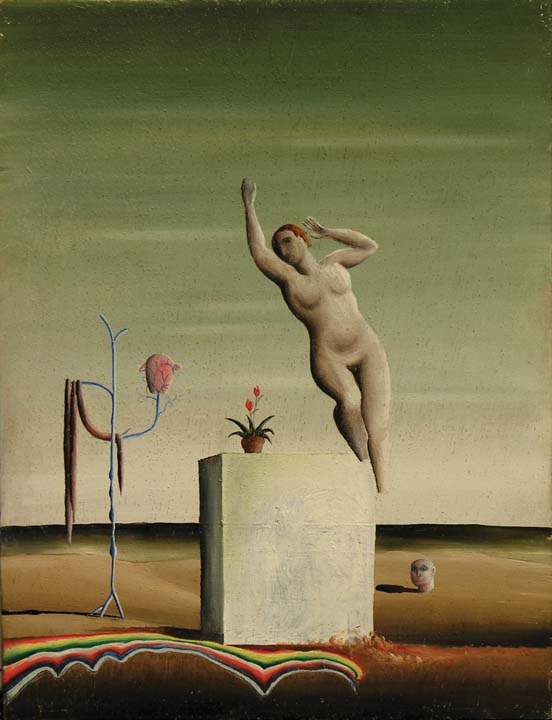
FOULQUE
(1904-1962)
There is little known about the personal life of the artist who worked under the pseudonym Foulque. A biographic manuscript, signed Gisèle F. (doubtless the artist’s partner) and drafted at the time of his death in 1962, was found in the artist’s studio along with a few other archival documents; this is the only document containing information about this underappreciated artist’s life.
Born in Paris in 1904 into a bourgeois family, Foulque was encouraged by his parents to develop his gift for drawing. He refused however to pursue his studies at the Ecole des Beaux-Arts, finding the curriculum to be too academic. He preferred to develop his own aesthetic, based on the attentive observation of the Parisian artistic movements happening around him.
His earliest known works date from 1928, and we can credibly place the beginning of his painting career around 1925. According to the aforementioned biographic manuscript, a change in the artist’s work coincided with the loss of the artist’s only child, who died shortly after birth. Around this time the drawing becomes much more realistic and the subjects darken little by little; the lively colors of earlier works give way to the gradations of grey, to the deep blacks and to the disturbing subjects. Foulque seems to have been deeply affected by the loss of his child, and the subjects of death and the embryo are two elements that were central in his work.
During the 1930’s Foulque’s work changed radically, and began to develop into his mature surrealist style. While comparisons can be drawn to other surrealist artists, it is doubtless Oscar Dominguez, to whom Foulque’s work and development are most closely related. Dominguez’s first surrealist works date from 1932 and are exactly contemporary of Foulque. The enigmatic and disturbing subjects set up in the foreground strongly evoke his art. As it often seems to be the case with surrealist painters, there is a sense of dark biting humor present in the work.
Having previously stayed within the shadows of his studio, decided by 1935 to enter the Parisian artistic stage. He participated, from June 20th till July 5th, 1938 in the Deuxième Salon des Jeunes Artists at La Galerié de Paris, Faubourg Saint-Honoré.
His works were exhibited alongside those of René-Maria Burlet and Charlotte Henschel, other surrealist artists and who would show later with the group Témoignage, created in Lyon in 1936 by Marcel Michaud. He also met with other artists such as Manessier, Jean Couty, Cavaillès (André Marchand), and the sculptors Germaine Richier and Jean Osouf among others.
At the same moment, when the surrealist movement moved to the forefront of the artistic stage, Foulque exhibited at the Salon d’Automne, and continued to do so until 1947. The address he is listed for indicates that he must have lived a life without financial constraints, the address being on the avenue du Parc Monceau, situated in the middle of a triangle formed by three majestic streets: the avenues Hoche and Friedland and la rue de Faubourg Saint Honoré, not far from la Place de l’Etoile.
Press reviews of the Salon in 1947 confirm that Foulque continued to paint in a pure surrealist vein through the end of the decade. If the war did not fundamentally change his style, it at least inspired him in painting some particularly despondent works, all with direct allusions to death or to the concentration camps.
In 1948, la Galerie de Berri, which had shown the work of Yves Brayer in 1942 and Marcel Mouillot in 1944, gave Foulque an exhibition, together with two other painters: Edouard Bollaert et Mathelin. While Oscar Dominguez continued to be an unmistakable influence for Foulque, during the 1940’s another artist fascinated him just as much: Yves Tanguy, whose certain works are quite similar stylistically.
Little by little, Foulque’s work changed, and by the end of the 1940’s the colors were slightly shrill, more garish, voluntarily disharmonious; the compositions more complicated, and the poetry that emanated from earlier works, even of the most terrifying type, disappears, leaving only the bizarre. In following with the artistic trends of his time, by the 1950’s Foulque moved into abstraction. The only real stylistic common point between all his periods of work, the early years, the surrealist and the abstract, is the widely brushed canvas with which Foulque always began his paintings up to his death in 1962.
*This biography is an excerpt from an essay prepared by Marie Watteau of Galerie Marie Watteau, Paris, France. Translation by Emily Mullins, Papillon Gallery.
|