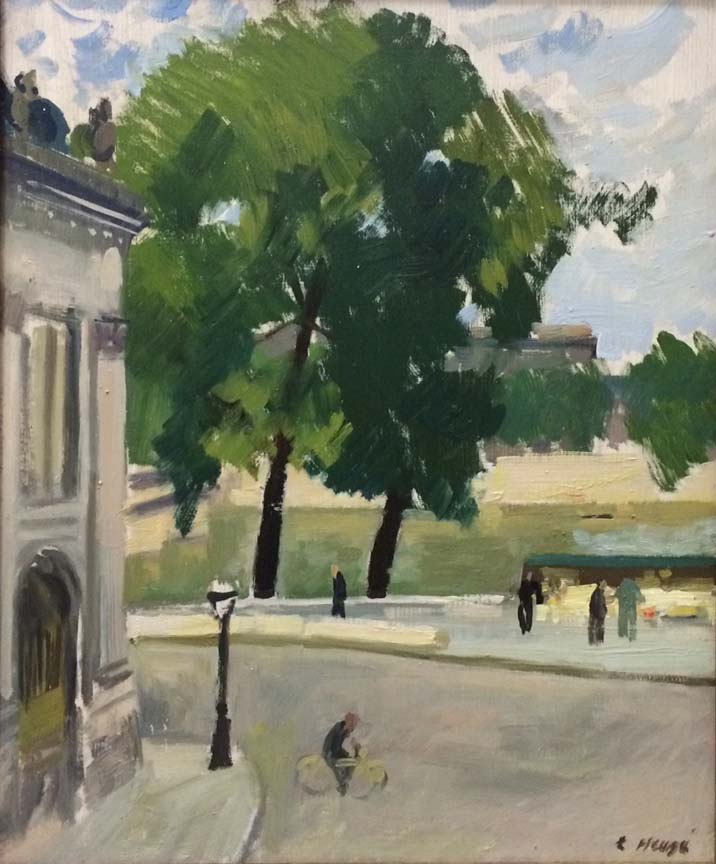
EDMOND AMEDEE HEUZE
"LA RUE"
OIL ON BOARD, SIGNED
FRANCE, C.1929
18 X 15.5 INCHES
Edmond Heuze 1883-1967 Edmond Heuzé was a painter, pastellist, watercolourist, and lithographer. His birth name was Amédée Le Trouvé. He was born in Paris, the son of a tailor and a seamstress. Heuzé wanted to be an artist from early childhood, and refused to follow his father into the tailoring profession. When he was 11, His parents moved to Montmartre, and it was there, in rue Cortot, that the thirteen-year-old Edmond Heuzé and his boyhood friend André Utter met Suzanne Valadon, whom Utter would later marry. Heuzé moved into an attic room in 8, rue Cortot, with another friend, the young Russian sculptor Laxine. For two years they studied under Valadon, until Laxine entered the atelier of Fernand Cormon at the Beaux-Arts; Laxine was soon to kill himself. Edmond Heuzé too studied under Cormon, but flounced out when Cormon made fun of his large nose. Discouraged, Heuzé took up a tailoring job at the department store La Samaritaine. But when his portrait of Suzanne Valadon was accepted by the 1902 Salon d'Automne, he resolved to devote himself to art. To support himself, Heuzé took a job as a dancer at the Moulin Rouge, where he danced with La Goulue. For two years he entered dance competitions across Europe under the name Williams. He also taught the painter Maurice Utrillo, who was the son of Suzanne Valadon. In 1908, Heuzé had his first solo exhibition, at the galerie Berthe Weill. The following year he went to Saint Petersburg, where he was the curator of the art collection of Grand Duke Nicolas. On the outbreak of WWI Edmond Heuzé returned to Paris to join up, but was only mobilized for a few months. In Paris he survived doing odd jobs in Les Halles. Continuing with his own art, Heuzé also acted as an intermediary between collectors and artists such as Picasso, Vlaminck, and Valadon. This led to Heuzé being appointed artistic director of the galerie Sagot in rue Lafitte. In 1920 Heuzé exhibited at Bernheim alongside Maurice Asselin, Emily Charmy, and Lucien Mainssieux. In 1923 an exhibition of paintings of filles de joie at the galerie Chiron finally made his name, and enabled him to live on the proceeds of his art. From this time Heuzé made the world of the circus a primary focus of his art; though he also painted portraits and views of Paris. He took over the former studio of André Utter at 38 rue Ramsey, above the café À la Belotte. Here he had an open teaching studio, becoming influential in the between-the-wars École de Paris, alongside now-more-famous figures such as Jules Pascin and Chaim Soutine. Heuzé won the Prix Paul Guillaume in 1938. In 1948 he was admitted to the Académie des Beaux-Arts of the Institut de France, to be joined the following year by his friend Jean-Gabriel Domergue; the two shocked the staid members of the Institut by their Bohemian ways. Nevertheless in 1951 Edmond Heuzé was appointed as Professor of Portraiture at the École des Beaux-Arts, a post that had lain vacant since the death of Léon Bonnat. He renewed his friendship with Maurice Utrillo, and was one of the mourners at funeral of Utrillo in 1955. Heuzé described his former pupil as "a genius without talent". Heuzé remained a true Bohemian till the end: Time Magazine, reporting in 1956 on the new popularity of striptease in Paris, where the International Amateur Striptease Contest was being staged, interviewed an enthusiastic Edmond Heuzé: "'I support the striptease out of admiration for female loveliness and respect for human dignity,' boomed 73-year-old Professor Edmond Heuzé, of the Beaux Arts Academy." Heuzé exhibited at the Wildenstein Gallery, London, in 1963, at the age of 80. There was a retrospective of his work at the Musée de Montmartre in 1972. Our colour lithographs by Edmond Heuzé are typically lively works, with a circus feel, inspired by that most seminal of Montmarte texts, Ubu Roi by Alfred Jarry. They were executed in 1947. |