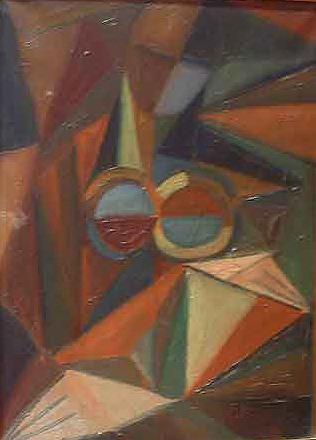
ELISABETH RONGET
"NU CUBISTE"
OIL ON CANVAS, SIGNED
FRANCE, C.1935
28.5 X 21 INCHES
Elisabeth Ronget Elisabeth Boehm Ronget
was born in 1896 in Conitz, Poland. Ronget’s career
as an artist is illustrative of the challenges faced by many artists
working at the beginning of the 20th century. Ronget was schooled in
traditional styles but quickly became engaged with the new approach
modernists were taking. What resulted for Ronget was a body of work
hat combines the skill of traditional training with the excitement and
exploration encouraged by Cubism. Ronget developed
a passion for drawing at an early age. Her parents recognized her interest
and sent her to the School of Fine Arts in Vienna. Her traditional schooling
involved academic drawing classes, and copying master paintings in museums. At the turn of the
century Viennese society was exploring the ideas of the avant-garde.
Secessionist movements began there as artists rebelled against traditional
restrictions on the definitions of art. It soon became apparent to Ronget
that what was occurring at a small level in Vienna was taking place
on a grander scale in Paris, London and Berlin. Having perfected classical
drawing technique, Ronget moved to Berlin in 1926 and became associated
with avant-garde artists in the November Group. In Berlin, Ronget
was exposed to Cubism and the works of Der Blaue Reiter that were working
in a colorful decorative style similar to the Fauves. With this exposure
Ronget understood that the early modernists were proposing an entirely
new way of making and considering art. Adopting the new tenets of modernist
painting, Ronget began exhibiting her Cubist pieces in restaurants and
bookstores. Some pieces were purchased which encouraged her to continue.
By 1930 the political situation in Germany had become dangerous and
in 1931 Ronget moved to Paris. She enrolled in the Académie de
la Grande Chaumière and made a living decorating restaurants
as well as designing fabrics and wallpaper for French fashion houses. In Paris she met
and married Paul Ronget, a doctor, who introduced her to painter André
Lhote. In Lhote’s studio Ronget discovered color and became familiar
with the revolutionary work of Paul Cézanne. Under the influence
of Lhote, Ronget’s forms simplified and her palate changed to
incorporate earth tones of ochre, browns, mauves and blues. In the academic
Cubism, which assimilated by Ronget, forms are flattened and simplified,
backgrounds are reduced to fields of geometric pattern. Ronget’s
choice of subject matter was in keeping with other Cubists and included
card players, musical instruments, and people gathered at bar. Biography courtesy of Kristin Poole. |